 EN
EN 中文简体
中文简体 English
 русский
 Español
 Português
 عربى
عربى

Content
- 1 Direct Answer: Which Certifications Apply
- 2 Why Certification Testing Matters
- 3 NFPA 2112 for Flash Fire Protection
- 4 EN ISO 11612 for General Heat and Flame Protection
- 5 Certifications for Electric Arc Protection
- 6 EN ISO 11611 for Welding Protective Clothing
- 7 Antistatic Certification for Explosive Atmospheres
- 8 Chinese National Standards for FR Fabric
- 9 How Fabric Gets Tested and Certified
- 10 Understand the Fabric Construction Behind Certification
- 11 Matching Certification to Your Industry
- 12 Common Mistakes When Reviewing Certification Documents
- 13 Frequently Asked Questions
- 13.1 Q1 What is flame resistant fabric
- 13.2 Q2 What is FR fabric
- 13.3 Q3 What makes fabric flame resistant
- 13.4 Q4 How does flame resistant fabric work
- 13.5 Q5 Is flame resistant fabric fireproof
- 13.6 Q6 What fabric is naturally flame resistant
- 13.7 Q7 Is cotton flame resistant
- 13.8 Q8 Is polyester flame resistant
- 13.9 Q9 Is aramid flame resistant
- 13.10 Q10 What is the best fabric for flame resistance
Direct Answer: Which Certifications Apply
There is no single certification that covers every use case for flame resistant fabric. Instead, the right standard depends on the hazard a worker actually faces. Flash fire exposure in oil and gas settings is generally addressed by NFPA 2112 in North America or EN ISO 11612 internationally. Welding work is covered separately by EN ISO 11611. Electric arc hazards are addressed by ASTM F1959, EN 61482 series standards, and referenced in NFPA 70E. Antistatic performance for explosive atmospheres falls under EN 1149 or the Chinese GB 12014 standard, while single layer flame retardant protective clothing produced in China is commonly tested against GB 8965.1.
Buyers sourcing through a flame resistant fabric manufacturer should match the certification to the actual workplace hazard rather than assuming one standard covers every risk, since flash fire, arc flash, welding, and molten metal splash hazards are each tested with different methods.
Why Certification Testing Matters
Certification standards exist to define repeatable test methods so a buyer can compare fabric from different sources on equal terms. NFPA 2112, for example, requires that fabric show a char length of no more than four inches and an afterflame time under two seconds after repeated laundering cycles, with a full garment manikin test limiting predicted second and third degree burn to under fifty percent of body surface area, according to NFPA technical documentation on the standard. These are not marketing claims, they are pass or fail thresholds tied to a specific laboratory test method.
A flame resistant fabric supplier that can walk a buyer through which test method applies to which hazard is generally easier to work with than one that only points to a general claim of being fire resistant without naming the standard behind it.
NFPA 2112 for Flash Fire Protection
NFPA 2112 specifies minimum design, performance, and certification requirements for flame resistant garments used in areas at risk from flash fire, such as oil and gas drilling, refining, and petrochemical processing. The standard also defines a Heat Transfer Performance test measuring how much thermal energy the fabric blocks before the wearer would be expected to suffer a burn injury.
Minimum heat transfer performance thresholds referenced in NFPA 2112 test documentation
NFPA 2112 uses the ASTM D6413 vertical flame test and the ASTM F1930 instrumented manikin test as its underlying test methods, and requires the fabric to show no melting or dripping across the test cycle.
EN ISO 11612 for General Heat and Flame Protection
EN ISO 11612 is the international counterpart most often referenced outside North America. It specifies performance requirements for garments protecting the wearer against radiant heat, convective heat, contact heat, and molten metal splash, and uses a modular letter code system from A to F so a buyer can see exactly which hazards a specific fabric has been tested against. This standard does not cover welding or structural firefighting, which are addressed separately by EN ISO 11611 and EN 469.
Where This Standard Is Commonly Referenced
- Oil and gas processing where flash fire and radiant heat risk overlap
- Steel and metallurgy operations exposed to molten metal splash
- Power generation and utility maintenance work
- General industrial maintenance involving open flame or hot surface contact
Certifications for Electric Arc Protection
Electric arc hazards are tested differently from flash fire hazards, since an arc flash releases an intense but very brief burst of thermal energy. ASTM F1959 is the test method used to determine the arc rating of a fabric, expressed in calories per square centimeter, while NFPA 70E defines how that arc rating maps to a required protective equipment category based on the calculated incident energy of a specific task.
Minimum arc rating in cal per square centimeter referenced in NFPA 70E PPE category tables
EN 61482 series standards serve a similar purpose in Europe, testing fabric response to both an open arc and a box test method, while ASTM F1891 covers arc and flame resistant rainwear specifically, since standard rainwear coatings are not automatically arc rated on their own.
EN ISO 11611 for Welding Protective Clothing
Welding introduces a different combination of hazards, including spatter, short flame exposure, and radiant heat close to the arc. EN ISO 11611 is written specifically for welding and allied processes and sets requirements separate from general heat and flame standards, which is why a buyer sourcing flame resistant workwear fabric for a welding shop should confirm this specific certification rather than assuming a general flame resistant rating is sufficient.
Antistatic Certification for Explosive Atmospheres
In petrochemical plants, gas stations, and coal mining sites, static discharge is a hazard on its own, separate from open flame. EN 1149 defines electrostatic property test methods for protective clothing, while GB 12014 is the equivalent Chinese national standard for antistatic clothing. Buyers working in these environments often need a fabric that combines flame resistance with a conductive thread grid or surface resistivity performance that meets one of these antistatic standards at the same time.
Antistatic Points Worth Confirming
- Whether the antistatic performance is tested on the finished garment or the raw fabric only
- Whether the conductive thread grid spacing meets the referenced standard
- Whether antistatic performance is retained after repeated industrial laundering
Chinese National Standards for FR Fabric
Buyers sourcing through an FR fabric manufacturer based in China should also be familiar with GB 8965.1, the national standard covering single layer flame retardant protective clothing, which sets test methods similar in purpose to NFPA 2112 and EN ISO 11612 but calibrated to domestic regulatory requirements. Fabric intended for both export and domestic Chinese markets is often tested against both an international standard and the relevant GB standard side by side.
How Fabric Gets Tested and Certified
Certification generally follows a similar path regardless of which standard applies. A fabric sample is submitted to an accredited testing laboratory, tested against the specific method defined in the standard, and issued a test report showing pass or fail against each requirement. Reputable FR fabric supplier operations repeat this testing periodically, not only on the first sample, since fiber blend consistency and finishing chemistry can drift slightly between production batches.
Relative focus comparison offered as general guidance, not a substitute for reading the full standard
Understand the Fabric Construction Behind Certification
Certification results trace back to how the fabric itself is built, not just the finished garment. The diagram below outlines the main layers involved in a typical certified flame resistant fabric construction.
- Face fabric weave, forming the outer surface exposed to heat or flame
- FR fiber blend, commonly aramid, modacrylic, or treated cotton fibers
- Conductive antistatic thread grid, woven at set intervals across the fabric
- Reinforced seam area, stitched with matching flame resistant thread
- Care label, listing the fiber content and referenced certification standards
Matching Certification to Your Industry
| Industry Setting | Primary Hazard | Commonly Referenced Standard |
|---|---|---|
| Oil, Gas, Petrochemical | Flash fire | NFPA 2112 or EN ISO 11612 |
| Welding and Fabrication | Spatter and short flame | EN ISO 11611 |
| Electrical Utility Work | Arc flash | NFPA 70E and ASTM F1959 |
| Steel and Metallurgy | Molten metal splash | EN ISO 11612 |
| Coal Mining | Flame and static discharge | GB 8965.1 and GB 12014 |
This table is a general starting point rather than a complete risk assessment. A workplace safety review should always confirm which standard applies to a specific task, since some settings combine more than one hazard at once.
Common Mistakes When Reviewing Certification Documents
- Accepting a general fire resistant claim without asking which specific standard and edition was tested
- Assuming a flash fire rating automatically covers arc flash or welding hazards
- Overlooking whether antistatic performance was tested alongside flame resistance
- Not confirming whether the test report covers the fabric weight and construction actually being ordered
About 3H Safety Technology Co Limited
3H Safety Technology Co Limited is a functional fabric manufacturer built around flame retardancy, marketed under the product brand 3H Safeloya. The company works as an OEM flame resistant fabric supplier and ODM FR fabric manufacturer in China, adding functions such as anti-static protection, arc protection, and metal splash protection according to customer requirements, alongside its core flame resistant fabric lines including aramid flame resistant fabric and modacrylic flame resistant fabric options.
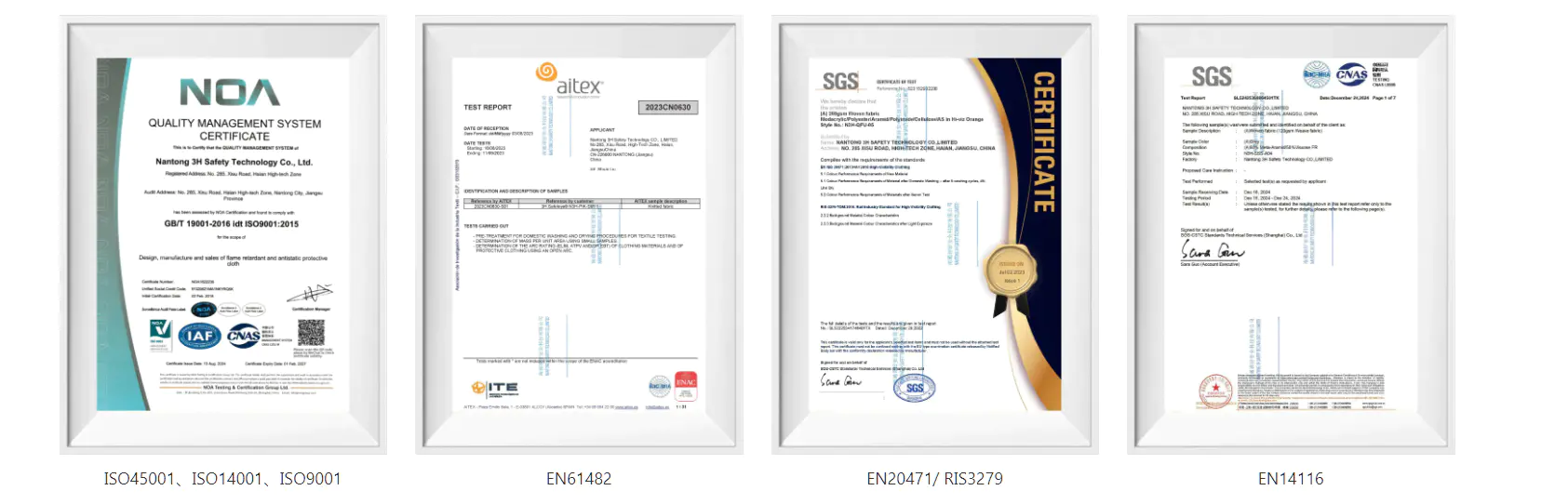
Products are used across petroleum, petrochemical, chemical, gas station, power, coal mining, steel, metallurgy, and mechanical processing industries. Related products have been tested by third party institutions including SGS in Switzerland, TUV in Germany, ITS in the UK, and a national labor protection products inspection center, referencing standards such as EN ISO 11611, EN ISO 11612, EN 1149, EN 469, EN 373, EN 61482, ASTM F1959, ASTM F1891, NFPA 70E, NFPA 2112, ANSI 107, GB 8965.1, and GB 12014. The company applies comprehensive quality management and product lifecycle traceability across its flame resistant fabric wholesale and FR fabric wholesale supply lines, including FR cotton fabric wholesale programs for buyers who prefer a cotton based fiber blend.
Frequently Asked Questions
Q1 What is flame resistant fabric
Flame resistant fabric is textile material engineered or treated to resist ignition, self extinguish, and limit flame spread when exposed to an open flame or intense heat source.
Q2 What is FR fabric
FR fabric is the common short form for flame resistant fabric, used across workwear, industrial, and protective clothing sourcing conversations.
Q3 What makes fabric flame resistant
Fabric becomes flame resistant either through fibers that are inherently flame resistant by their chemical structure, or through a flame retardant treatment applied to a base fiber such as cotton.
Q4 How does flame resistant fabric work
When exposed to flame, the fabric resists ignition, chars rather than melts, and self extinguishes once the flame source is removed, which limits how much heat reaches the skin.
Q5 Is flame resistant fabric fireproof
No fabric is completely fireproof under all conditions, flame resistant fabric is designed to reduce burn injury risk and limit flame spread rather than remain entirely unaffected by fire.
Q6 What fabric is naturally flame resistant
Aramid fibers are naturally flame resistant due to their chemical structure, along with wool to a lesser degree, without needing an added flame retardant treatment.
Q7 Is cotton flame resistant
Untreated cotton is not flame resistant and burns readily, though cotton can be treated with a flame retardant finish to meet specific protective clothing standards.
Q8 Is polyester flame resistant
Standard polyester is not flame resistant and tends to melt when exposed to heat, which is why it is generally avoided in protective clothing near flame or arc hazards.
Q9 Is aramid flame resistant
Yes, aramid fiber is inherently flame resistant and is widely used in fabric certified against flash fire, arc flash, and welding protective clothing standards.
Q10 What is the best fabric for flame resistance
The right choice depends on the specific hazard, aramid and modacrylic blends are common for flash fire and arc protection, while treated FR cotton is often chosen for comfort in general industrial workwear.